
Maritime · Ship-to-ship bunkering
Positioning for ship-to-ship bunkering.
Distance, direction and closing speed between two ships in real time. For safe manoeuvres during bunkering.
Risks
Ship-to-ship transfer runs in three phases: approach, contact and mooring, then transfer. Alternative fuels such as LNG, ammonia and methanol aim to reduce climate impact. The consequences of an incident can become more severe.
172 injuries and 6 fatalities per year during mooring
Fire during a ship-to-ship transfer, Black Sea 2019: 2 tankers, at least 10 fatalities
Reuters, 2023. Source cited in the 14 October pitch deck.
≈ 4,000 t of oil from tanker incidents in 2025 alone
Ammonia: life-threatening at 0.03 % in air
NIOSH, Ammonia. Immediately dangerous to life or health threshold: 300 ppm.
Methane: 80 times as climate-active as CO₂ over 20 years
UNEP, Facts about Methane. Rounded comparison of global warming potential.
EU target 2050: −80 % greenhouse-gas intensity of energy used on board (FuelEU Maritime)
European Commission, FuelEU Maritime. Compared with the 2020 average.
Shared, measurable criteria for safe contact do not exist yet.
Terraformer's approach is to measure contact, distance and relative motion and provide them as data.
From approach to hose connection
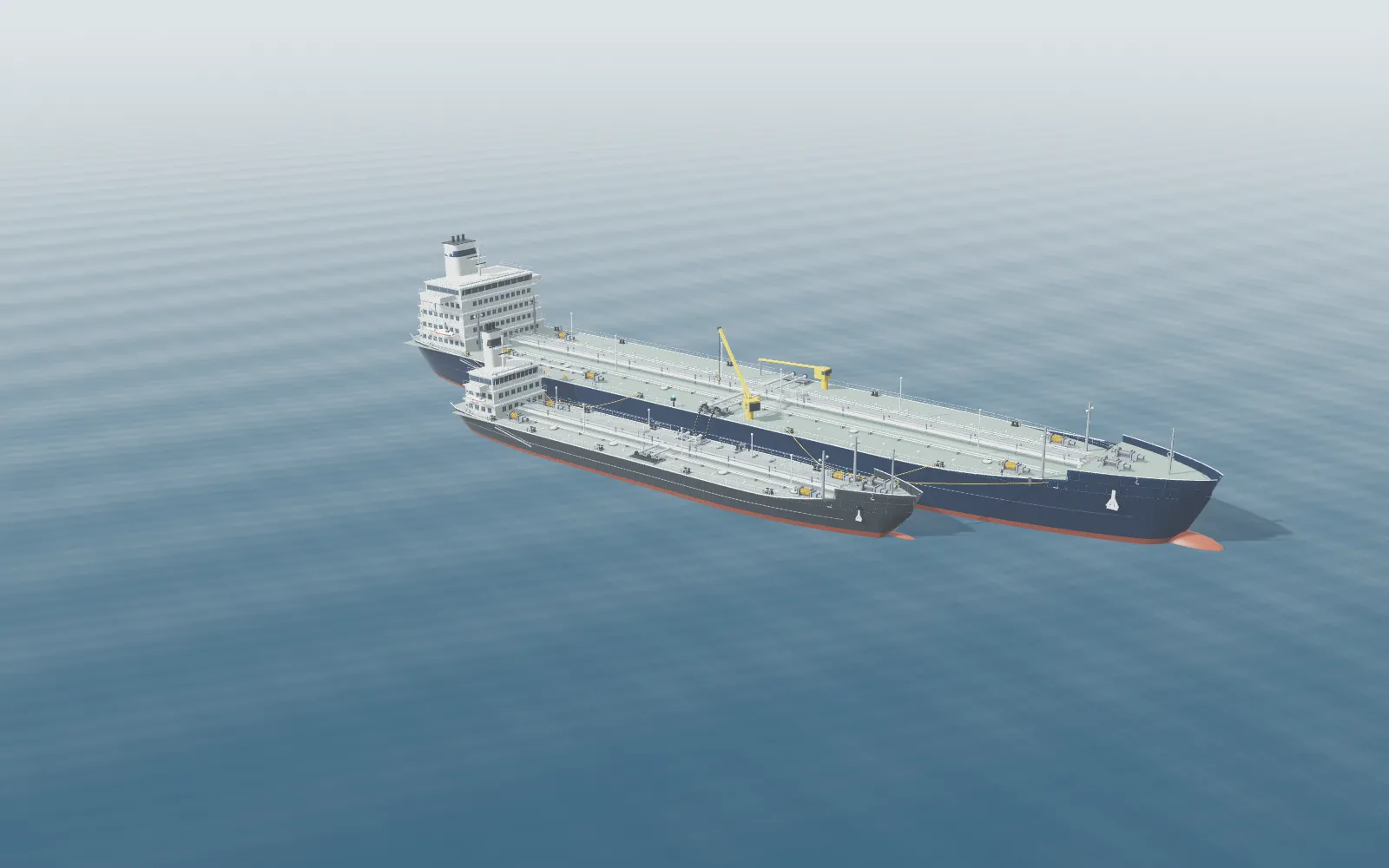
The four phases of a ship-to-ship transfer. The sensor measures throughout the approach.


Animation of a ship-to-ship transfer at sea, in four steps. A small tanker comes up from astern on the starboard side of a large tanker that holds its course, and turns parallel. A sensor on the large tanker's rail measures the distance to blinking markers on the small tanker. Four large fenders float between the hulls, two smaller ones hang at bow and stern. Mooring lines go across fore and aft. A crane lifts two hoses to the manifold in the middle of the large tanker.
Approach
One ship maintains its heading. The manoeuvring ship comes up from astern and settles onto a parallel course. Our sensor measures distance, direction and closing speed to its markers.
Fenders
Four large air fenders float along the straight part of the hull. Two smaller ones hang at bow and stern. The ships come together on the fenders, parallel and slowly.
Mooring lines
Lines go across fore and aft. Springs first, then breast lines, then head and stern lines. They hold both ships together.
Hose connection
The crane lifts the hoses across to the manifold midships. A saddle at the rail carries them. Then the transfer can start.
On-board equipment
Mount
Sensors are mounted on the ship holding course, with light markers on the manoeuvring ship. Both can be retrofitted.
Measure
Distance, direction and closing speed, in real time, through the whole manoeuvre.
Act
Measurements appear on the crew’s existing displays.
Results and reliability
Measurements document the course of the manoeuvre.
| Results and reliability | Status |
|---|---|
| Every manoeuvre logged with a time stamp | sourced |
Status
Working laboratory prototype for use above water, co-funded by Land Tirol.
Patent. Granted in Austria, international application filed.
Measuring principle. Published at WACV 2024, co-authored by Dr. Germain Haessig.
Contact
We will get back to you.