
Docking guidance for underwater drones
Coded lights on the dock. A special camera in the drone's nose. Position and angle for the autopilot.
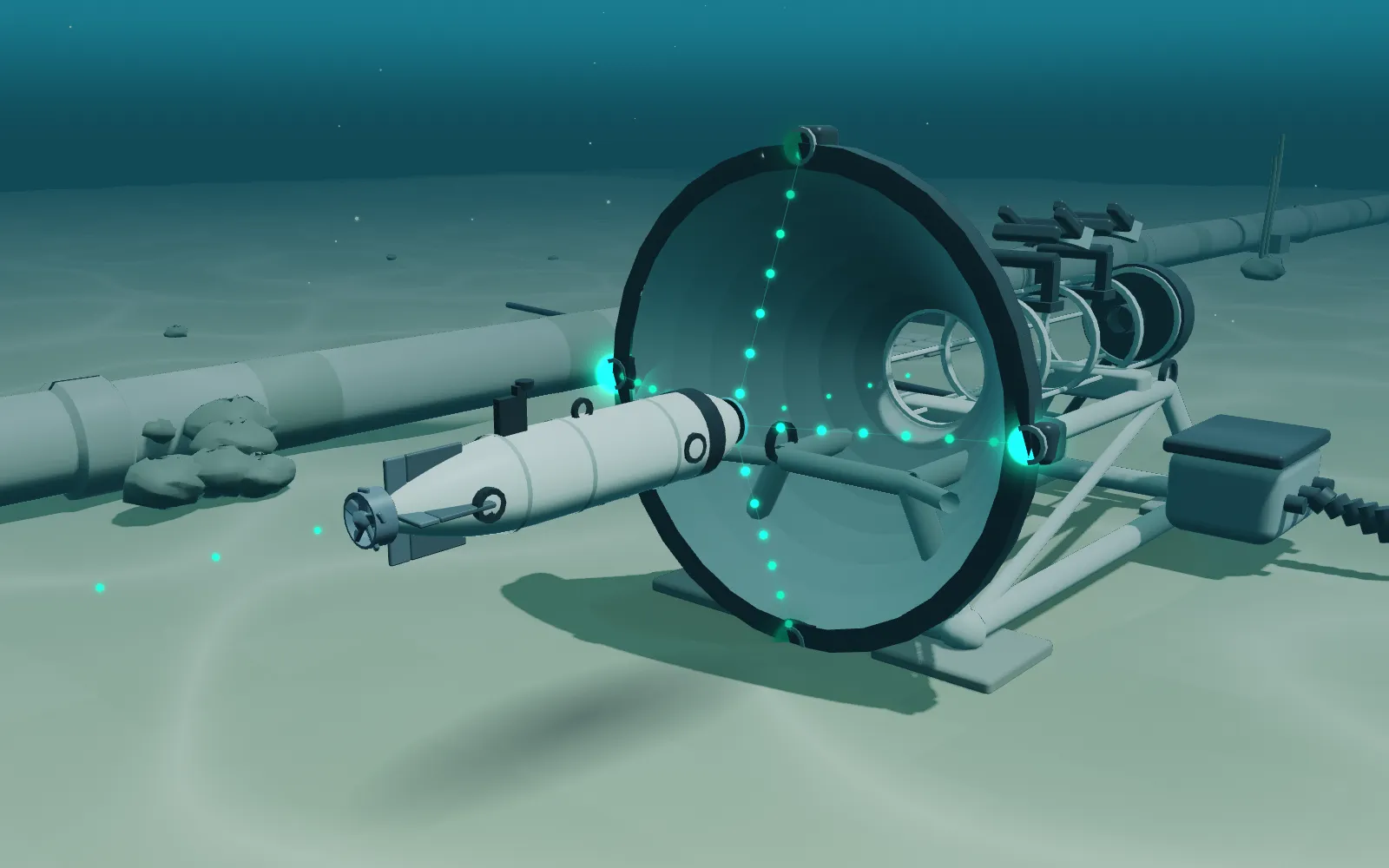
Measuring and steering during docking


Concept animation under water, in four steps. A docking station stands on the seabed next to a pipeline, with an entry funnel and four blue-green lights on its rim. Each light blinks in its own pattern. An underwater drone returns from its inspection run. The sensor in its nose reads the lights, the drone lines up on the funnel's axis and steers in. It slides into the docking tube, the latch closes and charging starts.
Coded lights.
Blue-green lights on the dock or cage. Each blinks in its own pattern. Blue-green light travels furthest through water.
Special camera.
The sensor in the drone's nose detects the coded lights.
Position and angle.
The system computes position and angle on board from the light pattern and sends them to the autopilot.
Docking.
The autopilot steers, the latch closes, charging starts.
Acoustic navigation still brings the drone close. Our sensor takes over for the final approach.
Underwater drones for inspection and monitoring
Seabed infrastructure
Pipelines, power cables and data cables need regular checks along their whole length.
Harbours and coasts
Underwater drones can monitor quays, hulls and approaches at night.
Autonomous charging and data transfer enable longer deployments.
Relative positioning for the final approach
GPS is unavailable under water and visibility is often limited. The final approach needs a direct measurement between drone and dock.
Challenges in the final approach
- Murky water.Cameras see haze, particles and glare. Structures often fade within a few metres.
- Moving docks.A cage under a ship moves with the waves. The drone has to match that motion.
- Little room.The drone has to enter a funnel only a few times wider than itself, on its own.
Without a reliable final approach, docking and recovery depend on divers, small boats or crane operators.
Two scenarios
Seabed dock
A drone inspects a pipeline and returns to a docking station on the seabed to recharge and upload its data. Our sensor guides it through the last metres into the funnel. The autopilot steers, the latch closes, charging starts.
Recovery to a ship
A docking cage hangs below the ship on a cable. It moves with the ship and the waves. Our sensor measures where the cage is. The drone matches its motion and steers itself in. The cage then brings it on board.
One measuring principle, above and below water
Ship-to-ship bunkering.
A sensor detects infrared lights on the other ship.
To maritimeUnderwater docking.
Blue-green lights on the dock or cage, the sensor in the drone's nose.
Status
Measuring principle. Published at WACV 2024, co-authored by Dr. Germain Haessig.
Working laboratory prototype for use above water, co-funded by Land Tirol.
Patent. Granted in Austria, international application filed.
Underwater positioning. Research agreement with an Austrian maker of underwater drones.
Underwater version. Blue-green lights, pressure-proof housing, first tank tests.
Next steps
Tank tests.
Coded lights and sensor, measured against a reference system.
Harbour trials.
A partner drone docks into a test funnel in calm open water.
Sea trials.
Seabed dock or ship-borne cage, in real currents and motion.
Pilot.
Integration with the drone's autopilot and the partner's dock or recovery system.
Order and timing depend on partners, test access and funding.
Partners and test access
- Pilot partners.Makers of underwater drones, docks and launch and recovery systems, and system integrators.
- Test access.Tanks, harbours and sea areas where a drone can dock under real conditions.
- Funding.Public and private funding to build and test the underwater version.
Contact
We will get back to you.